Help Me Help You Fight the FUD

In my presentation at Blogwell, at which I introduced our new Mayo Clinic blog for patients and employees, Sharing Mayo Clinic, I closed with a Jerry Maguire appeal:

[youtube=http://www.youtube.com/watch?v=p-oHuogx6_Y]

Many of the questions I got after the presentation, and that I get in other contexts from people wanting to implement social media programs at work, began something like: “What about the concerns that …” or “What about the fears that ….”

One of my points in response is that it’s extremely helpful to have external consultants who can help reassure leadership that the social media advocates in the organization aren’t crazy, and that lots of other companies and similar groups are using blogs and social media successfully, and without major problems. Shel Holtz and Andy Sernovitz helped us.

It’s also great to be able to point to examples of success, like Nuts about Southwest.

I hope Sharing Mayo Clinic can be the kind of example you can show your leaders, and say “See! If an established organization like Mayo Clinic is using blogs and Facebook and YouTube, we can too.” I’d love it if our example can help you fight the FUD (fear, uncertainty and doubt) barrier in your organization.

Of course, a big part of you being able to use our blog as an example of corporate blogging success is…well…for us to succeed.

You can help me with that in two ways: Suggesting Improvements and Spreading the Word.

Suggesting Improvements. In response to the post I did announcing the blog Thursday, SMUGgle Scott Meis (who I got to finally meet for the first time at BlogWell), left a good suggestion in the comments that I have implemented. It tripled the number of RSS and email subscribers we got in the second full day of the blog’s operation, as compared to the first. So, I hope you’ll check out Sharing Mayo Clinic, and I’d really appreciate any further suggestions you could offer on how we can improve.

Spreading the Word. Obviously building traffic to Sharing Mayo Clinic is our responsibility, and we’re communicating with our Mayo Clinic patients and employees about it. But if you would help spread the word by blogging or tweeting about it, or posting it on your Facebook profile or sending it to your friends, that would be fantastic, too.

And hopefully by helping me, I can help you fight the FUD.

Blogging with the Coast Guard

Now that my presentation at BlogWell is done, I’m listening to Commander Ron LaBrec talk about what the U.S. Coast Guard is doing with blogging and social media.

One of the best quotes, from one of his superiors: “You’re already in the social media environment. If you choose not to engage, you’re assuming all the risks with none of the potential benefits.”

Coast Guard engaged a consultant to help them find ways to listen to the relatively small portion of the blogosphere concerned with the Coast Guard. The consultant developed a dashboard in Pageflakes to pull the feeds together.

Here is iCommandant, the Coast Guard’s main blog, authored by Admiral Thad Allen.

The Coast Guard also has a Flickr account and a YouTube channel, as well as a Twitter presence. Here’s some video from the US Airways crash:

[youtube=http://www.youtube.com/watch?v=3mLKfRVU3qM]

iCommandant has helped set the agenda for some many non-Coast Guard blogs concerned about some of the same issues.

Instead of just using social media for PR and communications, they’re now looking at how these tools can change the way the organization works.

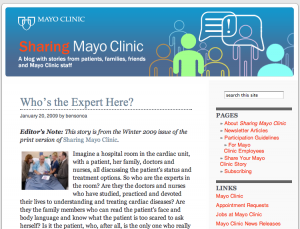
Sharing Mayo Clinic

Sharing Mayo Clinic
Sharing Mayo Clinic

Today we take a significant step for Mayo Clinic, launching our “culture” blog for patients and staff, called Sharing Mayo Clinic. I’ll be showing it as part of my presentation at BlogWell.

Sharing Mayo Clinic (at sharing.mayoclinic.org) is in many ways the culmination of a process we’ve had in the works for the last few years, starting with our first podcasts in Sept. 2005. As you can see in the post announcing Sharing Mayo Clinic my colleague Elizabeth Rice published this morning on our Mayo Clinic News Blog, we’ve had some other significant milestones that have helped bring us to this point, such as establishing a Facebook page and a YouTube channel. (You’ll also see some video of me talking about the project.)

But in another sense, Sharing Mayo Clinic is less recent and more timeless; it’s a logical extension of what Mayo Clinic patients have been doing for more than a century. Word of mouth from patients is the number one reason people give as their source of information about Mayo Clinic. Like our Facebook page, this blog is just a new way for patients to share their stories.

Sharing Mayo Clinic also will be a way to feature the work and stories of Mayo employees in various roles throughout the organization, who all contribute to creating the Mayo Clinic experience for patients and their families.

The blog is a work in progress, and we look forward to seeing it grow into a hub for Mayo Clinic’s various social media platforms. We have some ideas for new features and functionality once we’re past the launch stage, but I’d really like to know what you think of it so far, and how you think it could be improved.

Please check it out and give me your feedback! And I’d really appreciate it if you’d take the time to pass this along to your friends using the “ShareThis” icon below.

Healthcare Blogging Audio Conference Next Week

On Jan. 28, I will be presenting at an audio conference entitled “Blogging: Communicating and Marketing to Key Audiences.” It’s sponsored by Strategic Healthcare Communications, and other presenters include:

  • Sarah Brandon, Manager, Internal Communications, Alegent Health, Omaha, NE
  • Lisa Dombro, Chief Development Officer and Vice President, Marketing, Neurologic & Orthopedic Hospital of Chicago
  • Mark Gothberg, Editor, eHealthcare Strategy & Trends, Rye, NY

I’m looking forward to hearing about their experiences, too. If you’d like to join the audio conference, click here for more information.

It’s not free like SMUG, but should provide some good case studies of using blogs in healthcare communications.