First Event in Second Life

As Mayo Clinic (specifically our Center for Innovation) hosted its first event today in Second Life, it also was the first time I have attended a Second Life event. You can read about the event here on our Mayo Clinic News Blog, and I also have uploaded some screen shots to our Mayo Clinic Facebook Page.

If you haven’t experienced Second Life, here’s a brief video snippet from today’s presentation to give you a feel:

Second Life has a different value proposition as compared to the social media tools I have more strongly advocated. For instance, for an educational event like today’s lecture, it provides a neat way for people from all over the world to be virtually in the same room. I thought it was neat that we had room monitors available to help newbies like me figure out the controls.

Second Life is not a way to reach a large audience. There were several dozen people (or their avatars) in this event today, which I think made it quite successful. But it does seem like a good way to have more in-depth interactions than may be possible through Twitter chats, for instance. And for discussions of sensitive subjects and medical conditions, the anonymity of an avatar offers some value.

Back in 2007 there was a lot of hype about Second Life, and many organizations rushed in to have a presence there. I’m glad Mayo Clinic is exploring this through our Center for Innovation, and seeing what uses make sense for us.

I wrote a post about Second Life back in 2007 that was misunderstood as trashing Second Life, when that wasn’t my intent at all. My point was that organizations that had been considering spending on Second Life should think Facebook first. I think that’s proven to be wise advice: at the time Facebook had 40 million monthly active users, and since then has grown to 400 million.

But I still think Second Life is worth exploring, and as I said, I’m glad we have some people at Mayo Clinic who are seriously experimenting with it. I personally will probably not be a super frequent visitor because I have a lot of other things going on, but I’m keeping an open mind.

How about you? Have you visited Second Life? What do you think of it? How do you see it being applied?

Debbie Weil on Social Media 101

Debbie Weil’s book on corporate blogging was one of the first I read as I was exploring social media and applying it at Mayo Clinic.

I’m honored that our work was featured so prominently in a Social Media 101 presentation she gave yesterday in Washington, D.C. She mentioned it via Twitter today, so I thought it would be good to share here:

Debbie has a lot of solid material the presentation. Her discussion of our Mayo Clinic experience is on slides 12-17, and I particularly like her Twitter tutorial that starts on slide 30. If you want to get her book, the link is below. Or you can get the updated Kindle version of the book here.

Widgetbox Widget Test

I used Widgetbox to develop this widget, which includes feeds from the Mayo Clinic YouTube channel, Twitter account and Sharing Mayo Clinic blog.

I’m currently experimenting with the free trial of the Pro version.

Facebook 125: Creating Community in Your Facebook Group

A Facebook group is like a garden, to borrow an analogy from Chance, the Peter Sellers character in Being There. It will not grow properly without cultivation.

Because a group is so easy to create, billions have been formed. Facebook currently has 400 million active users, and the average user is a member of 13 groups. Do the math.

The vast majority of Facebook groups have precious little activity.

As a group administrator, you have tools at your disposal that the other members don’t have, and which are crucial to keeping the group vital and active.

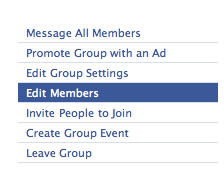
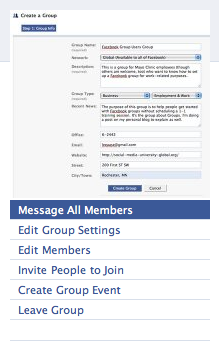
First, you can Message All Members by picking this in the left navigation:

This enables you to send a message to the Facebook Inbox of all group members. A good time to do this is when there is a Discussion Board topic or Wall post for which you would like their feedback…or a new video that has been uploaded, or a new event created.

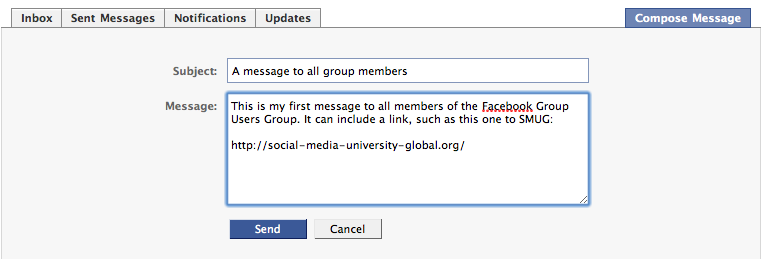
So when I created the Facebook Group Users Group, I used Message All Members to send this message (click to enlarge):

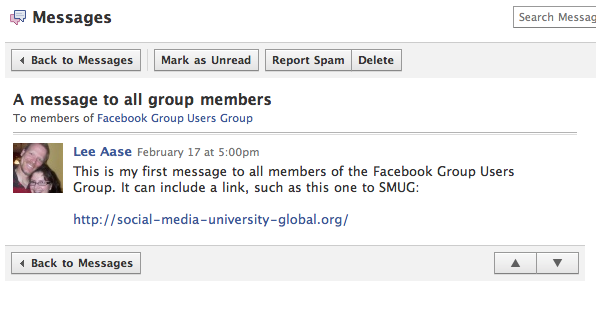
Which looked like this in my Inbox when I received it:

This is a way to keep your group top of mind among members. Don’t abuse it by sending too many messages; otherwise your group members will leave. But if what you are sending is meaningful and worthwhile to them, they will welcome it.

Your goal should be for the group to be useful to its members. If you are sending a message just to keep the group going, and not to help your members, that’s a sign you’re doing it for the wrong reasons. And your members will sense it.

Remember, the group doesn’t exist for itself; it exists for its members.

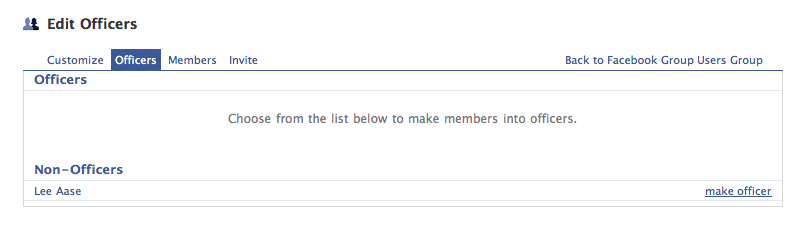
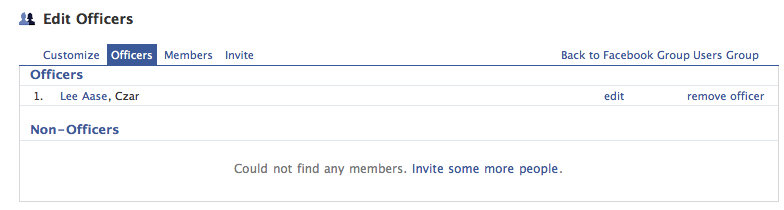
You also may want to Edit Members of your group to designate some of them as Officers or Admins.

Be careful with your designation of an Admin; these individuals will have the same rights with the group as you, the creator, do. But you may wish to have at least one additional trustworthy person as an Admin.

Officers, on the other hand, can be multiplied. By designating officers with any range of titles you can enable group members to find the person who may best be able to answer questions. In an academic program interest group, for instance, you may have someone other than the group creator designated as Program Director or Admissions Counselor. Or if you were to use Facebook as an online newsroom, you could indicate what specialty beats a particular staffer covers. In this way, a member can send a private inbox message in Facebook to a designated officer, such as a journalist identifying the staffer who covers the cardiology beat.

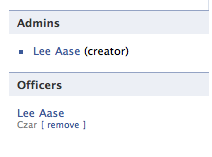
Then when you look on the front page of the group, your officers will be listed, so interested members or visitors can know which person they should contact.

I don’t know what I was thinking when I did this originally; I can’t believe I chose “Czar” as my office instead of “Chancellor.” I’ve since fixed that.

In my opinion, having an active group in Facebook requires an Admin who is committed to regularly adding content that is useful to members, and who takes time to reach out and remind members of the new content (without overdoing it and causing people to leave the group.)

What’s your experience? How else do you create community in a Facebook group?